
CORTEX Façade Engineering

Products · 07

Greenhouse insect screening

Mesh 40 anti-thrips screening at the roof vents

Every roof vent in the house is screened, so that the opening which lets hot air out does not let insects in. The screen is a woven net of polyethylene-coated monofilament fine enough to stop thrips, and with them the larger pests that follow thrips through an open vent. It is pest control by exclusion — nothing to spray, and nothing to run once it is fitted.

The trade is straightforward and worth stating plainly: every net that stops an insect also obstructs air. Screening a vent reduces its effective ventilation area, so the vent area has to be sized for the screened condition rather than the open one, or the house will simply run hotter than the design intended.

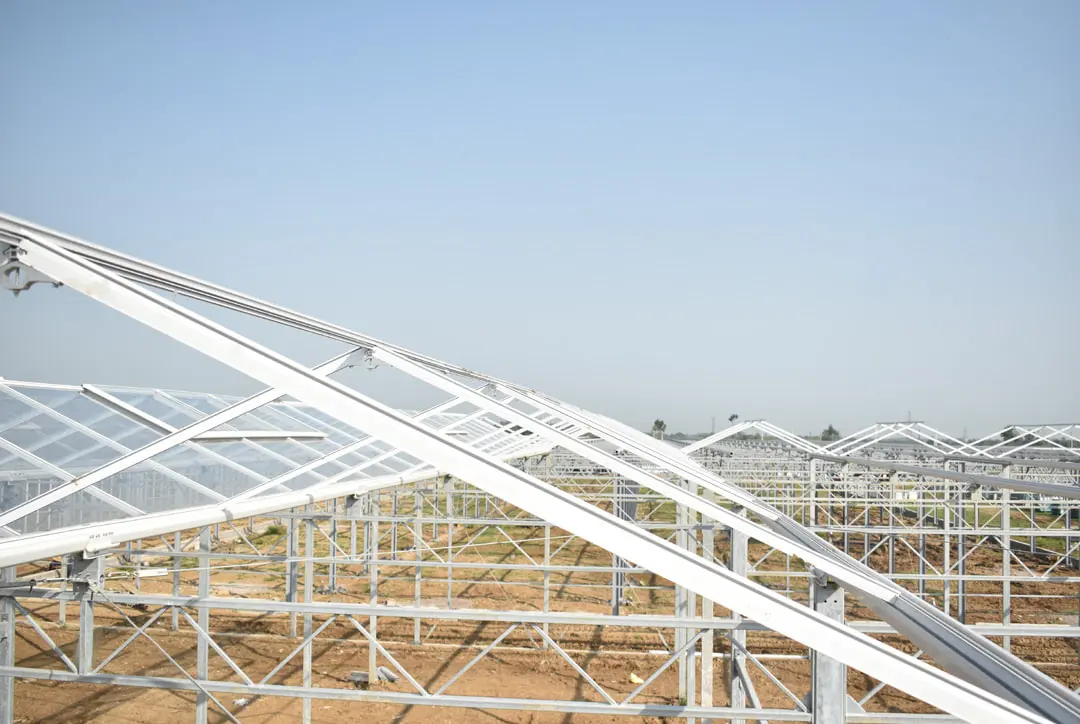
Greenhouse ridge showing the Venlo arm, push-up bar and ventilation opening against the sky

Choosing the mesh

Mesh choice follows the pest. The relevant dimension is the thorax width of the insect being excluded, and thrips are among the smallest that matter commercially — which is why anti-thrips netting sets the standard: a screen that stops thrips stops whitefly, aphid and leaf miner as well.

Better Farm specifies mesh 40 in white. The pests actually present in the region, and their size, decide the selection, and they are established during the site studies rather than on the day of installation.

Mesh size: what the number means

Mesh is counted, not measured. Mesh 40 means forty openings per linear inch, which is why a mesh number on its own is an incomplete specification: two nets at mesh 40 woven from different thread diameters have different hole sizes and different air resistance. The dimension that actually excludes an insect is the hole, and what decides whether an insect fits through it is the width of its thorax.

Diagram What the mesh number does and does not tell you
  • Counted, not measured Mesh 40 is forty openings per inch. The thread decides how big each opening is — and how much air it lets through.

  • The smallest pest sets it A hole narrower than a thrips' thorax stops thrips, and with them whitefly, aphid and leaf miner. Set for the largest and the smallest walks through.

  • Finer is not better A finer net obstructs more of the vent: a larger vent or a hotter house. The right mesh is the coarsest that stops the pests actually present.

Specify for the smallest pest present and the rest are covered; specify for the largest and the smallest walks through.

That is why anti-thrips netting sets the standard for greenhouse screening. Thrips are among the smallest pests that matter commercially, so a screen that excludes them excludes whitefly, aphid and leaf miner as well.

Finer is not better. Every step finer costs air. A screen that stops a smaller insect obstructs more of the vent, which reduces the effective ventilation area, which means either a larger vent or a hotter house. There is no mesh that costs nothing, and the right mesh is the coarsest one that excludes the pests actually present on that site — which is why the selection comes out of the regional pest study rather than a catalogue. How the vent is sized around it is set out under roof ventilation.

Colour is a specification, not a finish. White is specified here. Screen colour affects both how much light reaches the crop and how insects behave at the screen, and a dark screen at a vent is a shadow across the roof for twenty years.

Ridge vents open over a mature crop growing under the glass
Better Farm · on site Ridge vents open over a mature crop. Each opening is where a screen goes, and each screen is paid for in air.

UV stabilisation

Polyethylene in full sun needs an ultraviolet stabiliser, added when the net is made, and the net still has to let the light through. The specification here is a 4% UV level.

Without stabilisation, polyethylene monofilament in full sun becomes brittle within a few seasons and fails at the fixings first — which means the screen tears at the perimeter and admits everything it was fitted to exclude, while still looking intact from the ground. The UV additive is what makes the screen a component with a service life rather than a consumable.

Why screen at all

A screen fights pests physically rather than chemically. It reduces the pesticide programme, protects the biological control agents that a spray programme would destroy, and it works while nobody is watching.

It is also what makes export-grade production realistic. Residue limits in export markets are tight, and every intervention avoided at the vent is one that does not have to be defended at the border.

Reference

Specification

Greenhouse insect screening — specification
Parameter Typical range
Material
Fabric Polyethylene-coated monofilament, anti-thrips grade
Colour White
UV stabiliser 4%
Specification
Mesh count 40 openings per linear inch
Pest it is set by Thrips — the smallest that matters commercially
Selection basis Pest species and size identified in the regional site study
Installation
Position Every roof ventilation opening
Vent sizing Vent area sized for the screened condition

Values for the standard Better Farm bay set, referenced to the governing codes. Project values are confirmed against the site's wind, snow and seismic figures, the crop and the equipment schedule before fabrication is released.

Design notes

What decides the detail

  • Screening costs ventilation

    Effective vent area falls once a screen is fitted. Size the vents for the screened condition or accept a hotter house.

  • Specify to the smallest pest

    A mesh that excludes thrips excludes everything larger. Choosing for whitefly alone leaves the door open to the pest that actually causes the losses.

  • UV level is a service life

    Unstabilised monofilament embrittles and tears at the fixings, where it is hardest to see and easiest to miss.

  • It protects the biology

    Exclusion is what makes biological control viable, because it removes the spray programme that would otherwise kill the predators too.

Reference

Common questions

  • What is anti-thrips net and why is it fitted to greenhouse vents?

    It is a woven screen of polyethylene-coated monofilament, fitted over every ventilation opening to keep harmful insects out. Thrips are among the smallest pests of commercial concern, so a mesh that excludes them also excludes whitefly, aphid and leaf miner. It is a physical method of pest control: it reduces the pesticide programme, allows biological control agents to survive, and works continuously without intervention. Better Farm specifies mesh 40 in white with a 4% UV stabiliser at every roof vent.

  • Does insect netting reduce greenhouse ventilation?

    Yes, and it has to be designed for. A screen adds resistance to airflow, so the effective ventilation area of a screened vent is lower than its geometric opening. The correct response is to size the vent area for the screened condition rather than the open one; screening a roof that was sized without it will simply make the house run warmer than the design intended.

  • What mesh size does a greenhouse insect screen need?

    Better Farm specifies mesh 40 in white at every roof ventilation opening. Mesh is counted rather than measured — mesh 40 means forty openings per linear inch — so the number alone is an incomplete specification, because two nets at mesh 40 woven from different thread diameters have different hole sizes and different air resistance. What actually excludes an insect is the hole size against the insect's thorax width. Anti-thrips netting sets the standard because thrips are among the smallest pests that matter commercially, so a screen that stops thrips also stops whitefly, aphid and leaf miner.

  • Does a finer insect screen give better protection?

    Only against smaller insects, and it always costs air. Every step finer obstructs more of the vent, which reduces the effective ventilation area and means either a larger vent or a house that runs hotter than designed. There is no mesh that costs nothing. The right specification is the coarsest mesh that excludes the pests actually present on that site, which is established in the regional pest study during the site work rather than chosen from a catalogue on the day of installation.

  • Why does insect netting need UV stabilisation?

    Because polyethylene monofilament in full sun becomes brittle within a few seasons without it, and it fails at the fixings first. That failure mode is the problem: the screen tears at its perimeter and admits everything it was fitted to exclude, while still obstructing the vent and still looking installed from the ground. The stabiliser is added when the net is made, and the specification here is a 4% UV level.

Send us the site, the crop and the climate file.