

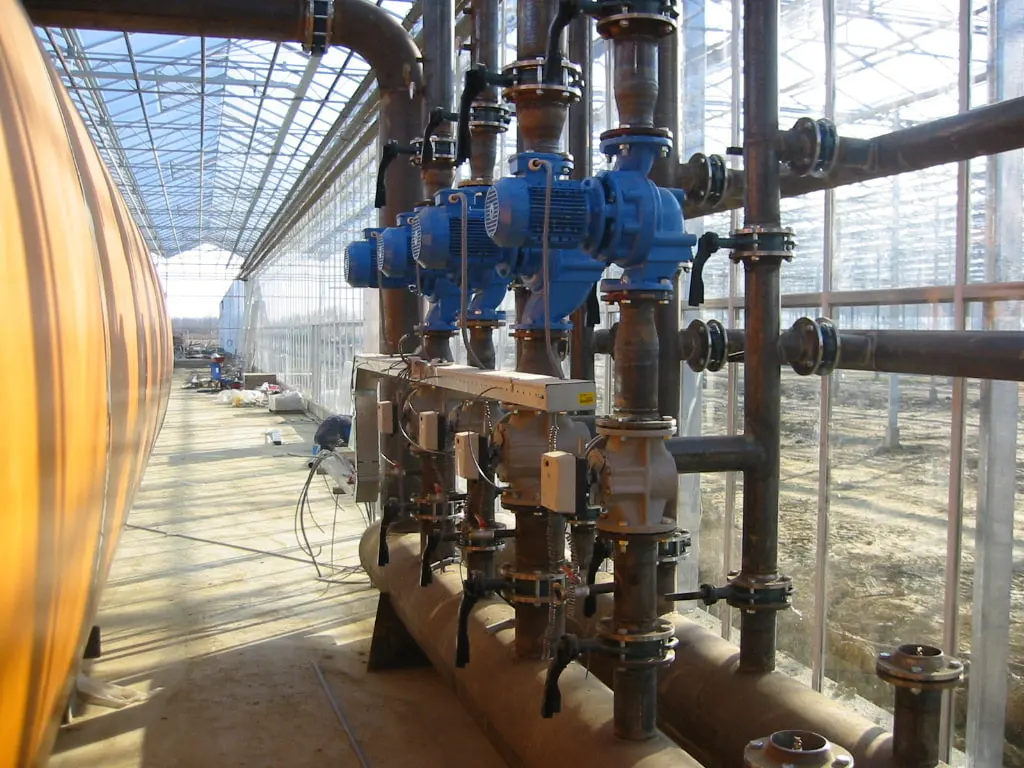
Cooling: the semi-closed system
A semi-closed system is among the most advanced ways of cooling a greenhouse. It works on the same evaporative principle as pad-and-fan, but instead of exhausting the moist air it recirculates it and recovers it for reuse — which cuts water and energy consumption significantly.
In an arid climate that distinction is the whole argument. Conventional evaporative cooling throws away both the water it has just evaporated and the cooling it produced; a semi-closed house keeps them. It also closes the ventilation path that insects and fungal spores use to enter, which reduces the pesticide programme as a side effect of the climate strategy.
Pad and fan remains the right answer on some projects. Which one a house gets is decided by the simulation, not by preference.
Pad-and-fan or semi-closed
Both are evaporative at heart. The difference is what happens to the air afterwards, and that difference decides the water bill, the pesticide programme and the capital cost.
-
Pad and fan Air drawn through a wetted pad warms as it crosses the house and is exhausted with the water it carried. The crop at the fan end lives in a warmer climate.
-
Semi-closed The treated air is fed in under the crop and taken round again. The water, the CO₂ and the cooling stay in the house, and the climate is even end to end.
In a pad-and-fan house the air warms as it crosses; in a semi-closed house it goes round again.
| Measure | Pad and fan | Semi-closed |
|---|---|---|
| Principle | Air drawn through a wetted pad and exhausted at the far end | The same cooling, but the moist air is recirculated and recovered |
| Water | Evaporated water leaves with the exhaust air | Recovered — a significant reduction |
| Energy | Lower capital, continuous fan load | Higher capital, lower consumption over the life |
| Insects and spores | The large air intake is a way in past the screening | Closed path — reduces the pesticide programme |
| Climate uniformity | A gradient from the pad end to the fan end | More uniform |
| CO₂ dosing | Largely wasted, since dosed air is exhausted | Retained, because the air is kept |
| Best where | Capital is constrained, water is cheap, the house is short | Water is scarce, the crop is high-value, the house is long, CO₂ dosing is planned |
The gradient is the practical argument people underestimate. In a pad-and-fan house the air warms as it crosses, so the crop at the fan end grows in a different climate from the crop at the pad end — measurably different, every day, in a building where uniformity is what allows a whole house to be harvested on one schedule.
In an arid climate the water argument is decisive. Where water rather than capital is the binding constraint — which is most of the region these houses are built in — keeping the water the cooling has already evaporated is usually the whole decision.
Heating: central boilers
For heating a modern greenhouse, a central boiler plant is the strongest choice, because it delivers heat more evenly than the alternatives.
Uniformity is the point. A crop does not respond to average temperature; it responds to the temperature at its own growing point, and a heating system with hot and cold ends produces a house where one row is a week ahead of another. A central plant with a distribution manifold and growing-pipe circuits puts the heat at crop level along the whole length, and a buffer lets the boiler run at its efficient point instead of chasing the thermostat.
-
Hot-water pipe at the crop The heat is released along the rows, at the growing point, and evenly from one end of the house to the other.
-
Warm air Rises past the crop and gathers under the glass, where it is lost fastest — while the rows stay cooler than the thermostat thinks.
Hot-water pipe releases its heat where the plants are. Warm air rises past them first.
Most of the heat a glasshouse loses at night goes out through the roof, which is why an energy screen drawn across it after dark is the cheapest large reduction in the heating bill — and why the heating and screen decisions are made together.

Geothermal heating and cooling
A geothermal heat pump uses the ground as a store of heat rather than as a fuel. A few metres down, the ground sits close to the local annual mean temperature all year, which makes it warmer than winter air and cooler than summer air — so the same installation heats in winter and cools in summer, by moving heat in the other direction.
The coefficient of performance is approximately 3 to 4, and that is the number the whole argument rests on. A COP of 3 means three units of heat delivered for each unit of electricity consumed, because the system moves heat rather than making it. A boiler, however efficient, delivers at most about one unit of heat for each unit of fuel it burns. On a greenhouse — a building with a very large heating demand running for twenty years — that ratio is the difference between an operating cost that compounds and one that does not.
-
Winter A few metres down, the ground is warmer than the winter air. The heat pump lifts heat out of it into the house.
-
Summer The ground is now cooler than the air, so the same loop runs the other way and puts the house’s heat into it.
-
A COP of 3 to 4 One unit of electricity moves two to three from the ground: three to four units of heat delivered. A boiler delivers at most about one for each unit of fuel.
The ground is steadier than the air above it. A heat pump uses that difference in both seasons.
Whether it is available on a site depends on three things, and all of them are ground facts established during the site studies rather than preferences.
- Ground conditions. Thermal conductivity, moisture content, and what can be drilled or excavated. Wet ground conducts better than dry; rock drills differently from alluvium.
- Area or depth available. A horizontal loop needs land the project may want for glass. A vertical borehole field needs depth and drilling access. Which one is viable is a site question.
- Groundwater. An open-loop system drawing and returning groundwater is more efficient, and needs the water, the permission and a way to return it.
It is capital-heavy and operating-light, and that trade should be explicit. Drilling and loop installation are a significant cost paid once, against a heating bill reduced for the life of the house. Whether it pays back depends on the heating demand — which depends on the climate, the crop's night temperature and whether an energy screen is installed — and on the local price of electricity against gas. It is modelled against the site's thirty-year record alongside the conventional options, not adopted on principle.
It combines rather than replaces. Geothermal is usually sized to carry the base heating load, with the central boilers covering the peaks, because sizing a ground loop for the coldest night in thirty years means buying capacity that stands idle almost all of the time.