
CORTEX Façade Engineering

Products · 05

Rainwater and condensate collection

Gutters, downpipes and the water a roof is worth

A hectare of glass is a hectare of catchment. In most of the places these greenhouses are built, that catchment is the best water the grower will ever have: rainwater has an electrical conductivity close to zero and none of the sodium or bicarbonate that makes well water expensive to correct before it reaches a crop.

So drainage on a glasshouse is not disposal. It is collection, and the discharge detail exists to get the water off the roof cleanly and into storage without it passing over the crop on the way.

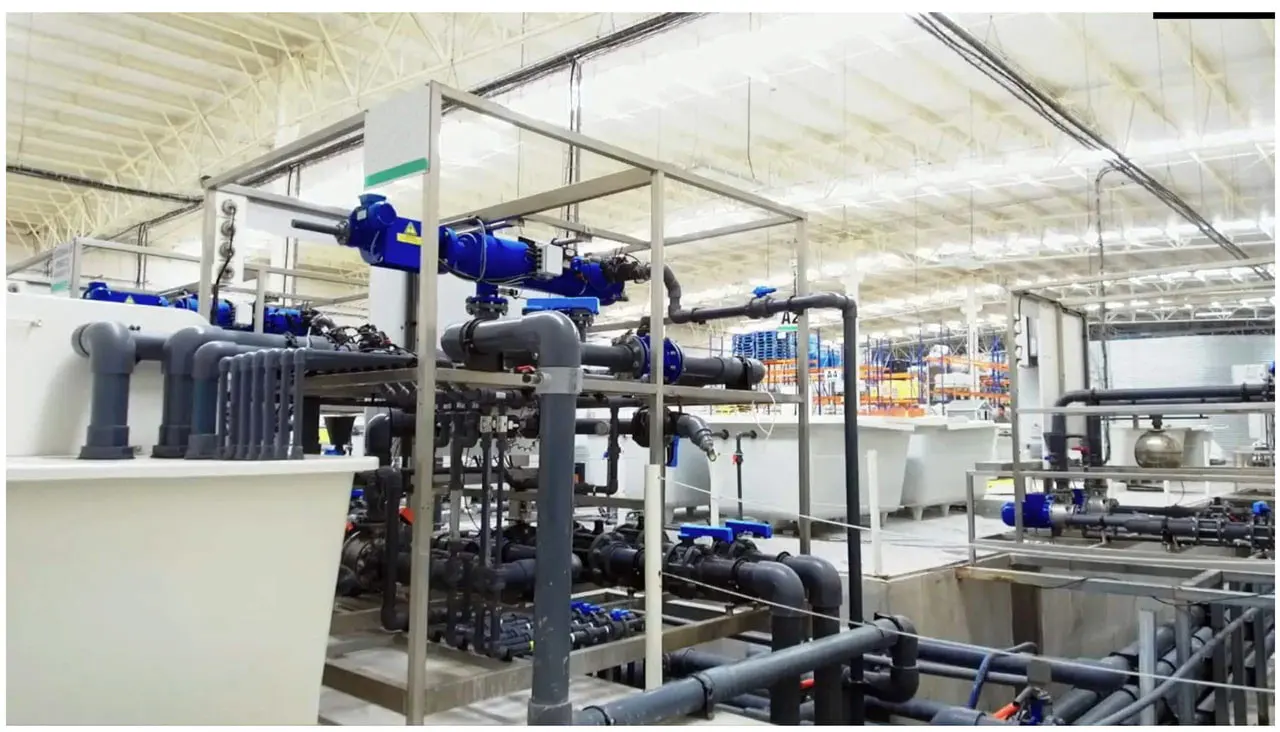
Greenhouse water treatment plant with filtration vessels, manifolds and storage tanks

The discharge

Water leaves through a 125 mm pipe in the gable bay, set against the inside face of the column line at the low end of the gutter. Keeping the downpipe inside the column line puts it out of the path of machinery working the perimeter and keeps the outside face of the gable clean.

Rain and condensate share the same route. Both arrive in the same gutter, and both are worth keeping.

Two greenhouse blocks and the packing hall seen from the air
Better Farm · on site Two blocks and the packing hall from the air. Every square metre of that glass is catchment, draining to one gutter line after another.

Condensation

In certain weather conditions condensate will form on the roof beam, the ridge, the gutter and other cold surfaces, and it will run. That is not a defect; it is what happens when a warm, saturated interior meets a cold single-glazed roof on a still night.

It matters because dripping water on a crop is a disease vector — free water on leaf tissue is what botrytis and downy mildew need. The whole glazing detail is built around directing that condensate: the PVC seat under each pane forms a channel, the roof bar leads water down to the gutter, and the gutter takes it to the downpipe. A roof that does not manage its own condensate is a roof that irrigates the crop with pathogens on a schedule set by the weather.

Diagram Where the condensate goes
  • Managed The PVC seat under each pane forms a channel; the roof bar leads the water down to the gutter, and the gutter to the downpipe.

  • Unmanaged Water that drips instead of running is a disease vector: free water on leaf tissue is what botrytis and downy mildew need.

The glazing detail decides whether the water that forms on the inside of the glass reaches the gutter or the leaves.

Storage and reuse

The downpipe is the first element of the water system, not the last. Rainwater harvesting and storage, UV disinfection, drain-water recovery and recirculation, filtration and desalination where the source water needs it, are all designed on the same project as the roof that feeds them.

Sizing the storage is a climate question rather than a plumbing one, and it is answered from the thirty-year rainfall record for the site: the amount of precipitation, snow and rain, over a thirty-year period, is one of the studies carried out before the structure is laid out at all.

From roof to root

Collecting the water is the easy half. What decides whether it is usable is what happens between the tank and the dripper, and on an irrigation system running a whole house it is not optional.

Diagram What the water passes through before it reaches the crop
  • From roof to root Storage is sized to the longest dry run in the record, not the annual rainfall. Filtering protects the drippers, UV makes recirculation safe, and the blend with a second source is set at design stage.

Each stage is sized from the site's own record and the crop's demand — and the blend ratio is set at design stage, not decided daily.

Storage sizes to the gap, not to the rainfall. The number that matters is not annual rainfall; it is the longest dry run the thirty-year record shows, set against the crop's daily demand. A reservoir sized on an annual average empties in the season it was needed. The record is read for the worst gap, not the mean.

Filtration comes before anything else. Roof water carries dust, organic debris and whatever the wind delivered, and drip irrigation does not tolerate particles — a blocked emitter is an unwatered plant that nobody notices until the row behind it is visibly behind.

Disinfection is what makes recirculation safe. Any system that returns drain water to the crop returns whatever pathogens are in it, and root diseases move through a recirculating system faster than by any other route in a greenhouse. UV disinfection is the usual answer: it uses no chemicals, leaves no residue in the water, and treats continuously in line.

Blending, because rainwater is almost too pure. Rainwater has an electrical conductivity close to zero, which is exactly why it is valuable — there is no sodium and no bicarbonate to correct before it reaches the crop. A fertigation system dissolves nutrients into water to a target EC, and starting from zero is not a problem; relying on rainwater alone and running out mid-season is. Most houses blend collected rainwater with a treated second source, and the ratio is a design decision, not a daily one.

Desalination where the second source needs it. Where the alternative supply is well water with high sodium, treating it is usually cheaper over twenty years than living with the yield penalty sodium imposes.

In arid regions — the Gulf, central Iran, much of Iraq — this is the argument for the whole roof. A hectare of glass is a hectare of catchment producing the best water the grower will ever have, and where water rather than land or capital is the binding constraint, that is often what makes the project viable at all.

Reference

Specification

Rainwater and condensate collection — specification
Parameter Typical range
Collection
Catchment Roof rainwater and interior condensate, one system
Gutter Extruded aluminium structural gutter, spanning the 4.00 m bay
Downpipe 125 mm, one per gable bay
Downpipe position Inside the column line, at the low end of the gutter
Storage and treatment
Storage sized from The 30-year rainfall record (rain and snow) against crop demand
Treatment train Filtration, UV disinfection, drain-water recovery; desalination where the second source needs it
Use Blended with a treated second source for fertigation

Values for the standard Better Farm bay set, referenced to the governing codes. Project values are confirmed against the site's wind, snow and seismic figures, the crop and the equipment schedule before fabrication is released.

Design notes

What decides the detail

  • Rain is the asset

    Roof water has near-zero EC. On a site with hard or saline groundwater it is the difference between dosing a nutrient recipe and correcting a water problem first.

  • Condensate is not a leak

    It is physics, and the detail manages it. What matters is that it reaches the gutter instead of the crop.

  • Inside the column line

    A downpipe on the outer face gets hit. Inside the line it is protected and the gable reads clean.

  • Size from the record

    Storage volume comes out of thirty years of rainfall data for the location, not from a rule of thumb per hectare.

Reference

Common questions

  • How is rainwater drained from a Venlo greenhouse?

    Roof water runs into the aluminium gutters at each valley and leaves through a 125 mm downpipe in the gable bay, set against the inside face of the column line, so the pipe sits inside the structure and out of the way of machinery. Interior condensate uses the same route. The downpipe normally feeds storage rather than a drain, because a hectare of glass is a hectare of near-zero-EC catchment and is usually the best water on the site.

  • Is condensation in a greenhouse a problem?

    The condensation itself is normal — it is what happens when a warm, saturated interior meets a cold single-glazed roof on a still night. What matters is where it goes. Water dripping onto a crop is a disease vector, because free water on leaf tissue is what botrytis and downy mildew need, so a roof that does not manage its own condensate irrigates the crop with pathogens on a schedule set by the weather. The whole glazing detail exists to direct it: the PVC seat under each pane forms a channel, the roof bar leads water down to the gutter, and the gutter takes it to the downpipe.

  • Can rainwater collected from a greenhouse roof be used to irrigate the crop?

    Yes, and in most places these houses are built it is the best water the grower will ever have — rainwater has an electrical conductivity close to zero and none of the sodium or bicarbonate that makes well water expensive to correct. Before use it needs filtration, because drip irrigation does not tolerate particles, and disinfection where drain water is recirculated, because root diseases move through a recirculating system faster than by any other route. Storage is sized against the longest dry run in the thirty-year record rather than against annual rainfall.

  • Why is the greenhouse downpipe placed inside the column line?

    Water leaves through a 125 mm pipe in the gable bay, set against the inside face of the column line. Putting it inside the line keeps it out of the path of machinery working the perimeter — a downpipe on the outside face is something a vehicle eventually finds — and keeps the external face of the gable clean. Rain and condensate share the same route: both arrive in the same gutter, and both are worth keeping.

Send us the site, the crop and the climate file.